04·Systems · Chapter 04
Scalable products
are systems.

Live Component Explorer
One primitive of many: Storybook.
Components are the visible edge of the system. Underneath sit tokens, API contracts, and DX conventions, the parts a team inherits without noticing.
Chapter 01 · Tokens
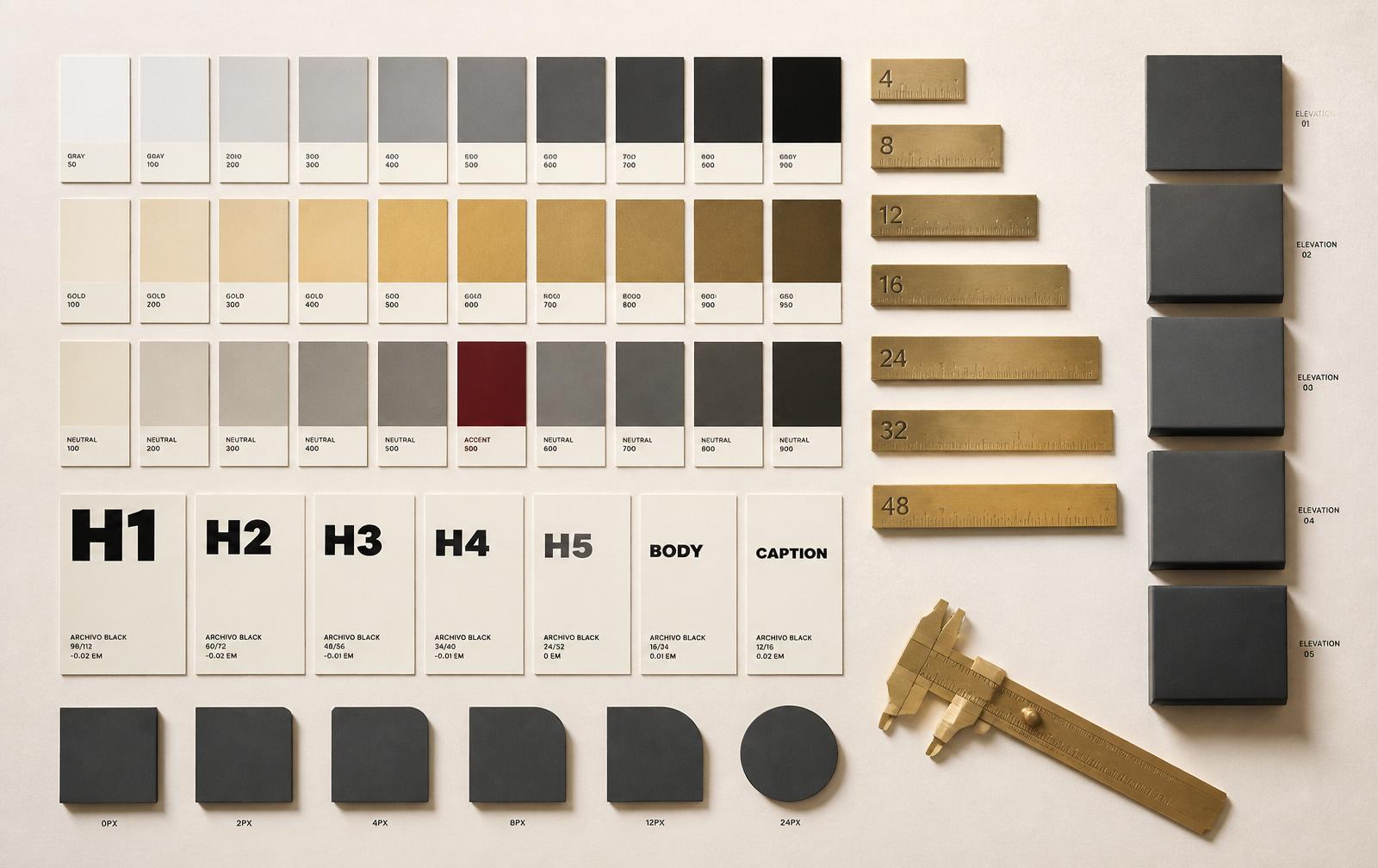
Design tokens as a language.
Color
- --backgroundsurface
- --foregroundcontent
- --surfaceelevated 1
- --surface-elevatedelevated 2
- --primaryactions
- --goldaccent · achievement
- --muted-foregroundsubtle text
- --borderhairlines
Spacing
Radius
Typography
Display / Hero
Systems that scale.
Display / L
Composable primitives
Body / L
Composition over configuration.
Body / S
Documentation is a product.
Mono / XS
TOKENS · TYPE · MOTION
Change a token · see it ripple
Tokens live
Change a token. Watch the component change. That's the contract.
--color-accent: oklch(0.52 0.135 78);
--radius-base: 8px;
--space-pad: 24px;
--density-scale: 1.05;
Component
Live token demo
Every visual decision flows through a token. Change one, everything downstream inherits it. No coordination meeting required.
Chapter 02 · Principles
How I build for scale.
01
Shape before surface
Data model and API contracts first. UI last. The shape decides everything downstream.
02
Boundaries are the product
Auth, ownership, and trust lines are named on purpose. Every ambiguity is a future bug.
03
Composition over configuration
Small primitives that combine. Fewer props, sharper APIs, less to memorize.
04
Tokens over hardcodes
Every visual decision goes through a token. One change ripples through every surface.
05
DX is UX for the next engineer
The paved road is the product. If it's easier to do it right, right is what ships.
06
Docs travel with the code
A component without an example is a component without a contract.
Chapter 03 · API
Component APIs shaped by intent.
The API is the product. It teaches, constrains, and rewards good composition.
Configuration (avoid)
<Card
  title="…" subtitle="…" icon={<X />}
  actionLabel="…" actionVariant="outline"
  showDivider hasFooter footerAlign="end"
  densityCompact
/>
Composition (preferred)
<Card>
  <Card.Header>
    <Card.Title>…</Card.Title>
  </Card.Header>
  <Card.Body>…</Card.Body>
  <Card.Footer align="end">
    <Button variant="outline">…</Button>
  </Card.Footer>
</Card>Scroll to assemble
A card is not a monolith. It is a contract between slots, each replaceable, each optional, each aligned to the same grid.
- 01
- CardHeader, eyebrow, controls, chapter marks
- 02
- CardTitle, the primary label
- 03
- CardContent, body prose, lists, media
- 04
- CardFooter, trailing actions
Chapter 04 · Motion
Motion as a system, not decoration.
01
Purpose
Motion earns its place by clarifying causality, what caused what, where the user is, what to look at next.
02
Duration
180–420ms for UI. 700–900ms for reveals. Never long enough to feel like waiting.
03
Easing
cubic-bezier(0.22, 1, 0.36, 1), a single expressive out-curve for everything.
04
Reduced motion
Motion is a feature, not a mandate. Honor prefers-reduced-motion, always.
05
Choreography
Sequenced stagger for lists. Solo reveals for hero moments. Never both at once.
06
Restraint
If it doesn't clarify, it distracts. When in doubt, remove.
Chapter 05 · The Handoff
Figma and code, sharing a language.
When tokens are the source of truth, Figma variables and code variables both point at the same intent. The handoff stops being a translation and becomes a lookup.
- Figma variables mirror Style Dictionary output.
- Component names in Figma match component names in code.
- State variants in design match slot APIs in code.
- Accessibility annotations travel with the component, not the ticket.
Chapter 06 · Inventory
Included in packages/ui.
Every component is typed, accessible, composable, documented, and styled entirely through tokens.
Chapter 07 · Scale
Why systems multiply teams.
01
One decision, many surfaces
A token, a contract, a boundary, decided once, inherited everywhere. No coordination meeting required.
02
Onboarding as a byproduct
New engineers learn the system, not the codebase. The system is the codebase.
03
Quality compounds
Accessibility, performance, and consistency are inherited by every new surface, not re-litigated per feature.